🏃 Ran the Seoul Marathon?
Log your result, build your race history, and plan your next marathon with RunningLog — connect Strava and your races sync automatically.
The 2026 Seoul Marathon — one of the oldest and most prestigious marathons in Asia — delivered a race for the ages on Sunday, 15 March. Ethiopia’s Haftu Teklu retained his title in the most dramatic fashion imaginable, clocking a course record of 2:04:23 after a heart-stopping sprint finish against compatriot Getaneh Molla, who was given 2:04:24 — just one second behind. In the women’s race, Ethiopia’s Haven Hailu Desse produced a commanding solo victory in 2:19:09 to complete an Ethiopian double at the World Athletics Platinum Label event.
The depth of the men’s race was extraordinary: all five podium finishers ran faster than the previous course record of 2:04:43, making this the fastest Seoul Marathon in the event’s 95-year history.
Men’s Race: One Second Separates Champion from Challenger
On paper, the men’s field was stacked. Sisay Lemma, the fourth-fastest marathon runner in history (2:01:48 in Valencia 2023) and winner of the 2024 Boston Marathon, was the headline entry. Defending champion Teklu returned in strong form after tuning up with a 1:02:25 half marathon in Dubai last month. Getaneh Molla (PB: 2:03:34), Tsegaye Getachew, and Kenya’s Gilbert Kibet all brought sub-2:05 credentials.
The race unfolded as a classic war of attrition. Six men were still together as the pack passed 40 km in 1:58:03, setting up a breathtaking final two kilometres. Molla was the first to make a move, surging away from the group — but Teklu tracked him stride for stride, refusing to let any gap open.
As the pair rounded the final bend toward the finish inside Jamsil Olympic Stadium — the iconic 1988 Olympics venue — Molla held a narrow advantage. It looked like the title might change hands. Then, with the finish line in sight, Teklu launched a perfectly timed kick, surging past Molla in the dying metres. Teklu began celebrating, but had to keep pushing all the way to the line to secure the win.
The clock read 2:04:23 for Teklu and 2:04:24 for Molla — a new personal best for the champion and a new course record, 20 seconds faster than the previous mark of 2:04:43. Behind the leading duo, three more men also dipped under the old course record: Gilbert Kibet (2:04:32), Tsegaye Getachew (2:04:33), and Sufaro Woliyi Kabeto (2:04:36). Kenya’s Enock Kinyamal rounded out a world-class top six in 2:04:46.
Notably absent from the top finishers was pre-race favourite Sisay Lemma, whose recent form (a DNF in Boston and 2:08:58 in Valencia in 2025) suggested the veteran’s best days at the sharp end of elite marathons may be behind him.
Men’s Marathon — Top 6
| Pos | Athlete | Country | Time |
|---|---|---|---|
| 🥇 1 | Haftu Teklu | 🇪🇹 Ethiopia | 2:04:23 ⭐ CR / PB |
| 🥈 2 | Getaneh Molla | 🇪🇹 Ethiopia | 2:04:24 |
| 🥉 3 | Gilbert Kibet | 🇰🇪 Kenya | 2:04:32 |
| 4 | Tsegaye Getachew | 🇪🇹 Ethiopia | 2:04:33 |
| 5 | Sufaro Woliyi Kabeto | 🇪🇹 Ethiopia | 2:04:36 |
| 6 | Enock Kinyamal | 🇰🇪 Kenya | 2:04:46 |
Women’s Race: Desse Commands from the Front
While the men’s race came down to the final metres, the women’s contest was decided much earlier. Haven Hailu Desse ran as part of a lead pack through the first half in 1:08:42 and through 30 km in 1:37:46, carefully measuring her effort. She made her decisive move after 35 km, pulling away from the group and running solo through 40 km in 2:12:01.
Nobody could follow. Desse crossed the finish line at Jamsil Olympic Stadium in 2:19:09 — a personal best and a comfortable 30-second winning margin. It was a commanding display from the Ethiopian, who had entered the race with a PB of 2:19:17 and was competing against several athletes with faster credentials on paper.
Behind her, Bekelech Gudeta secured second place in 2:19:39, also a personal best, while compatriot Bosena Mulatie completed an Ethiopian top-three sweep in 2:19:47. Kenya’s Joyce Chepkemoi Tele was a notable fourth in 2:19:50 — breaking the 2:20 barrier for the first time in her career. Pre-race favourite Tiruye Mesfin, who had the fastest personal best in the field (2:18:35), faded to fifth in 2:20:45.
Women’s Marathon — Top 5
| Pos | Athlete | Country | Time |
|---|---|---|---|
| 🥇 1 | Haven Hailu Desse | 🇪🇹 Ethiopia | 2:19:09 PB |
| 🥈 2 | Bekelech Gudeta | 🇪🇹 Ethiopia | 2:19:39 PB |
| 🥉 3 | Bosena Mulatie | 🇪🇹 Ethiopia | 2:19:47 |
| 4 | Joyce Chepkemoi Tele | 🇰🇪 Kenya | 2:19:50 PB |
| 5 | Tiruye Mesfin | 🇪🇹 Ethiopia | 2:20:45 |
The Course: From Gwanghwamun to the Olympic Stadium
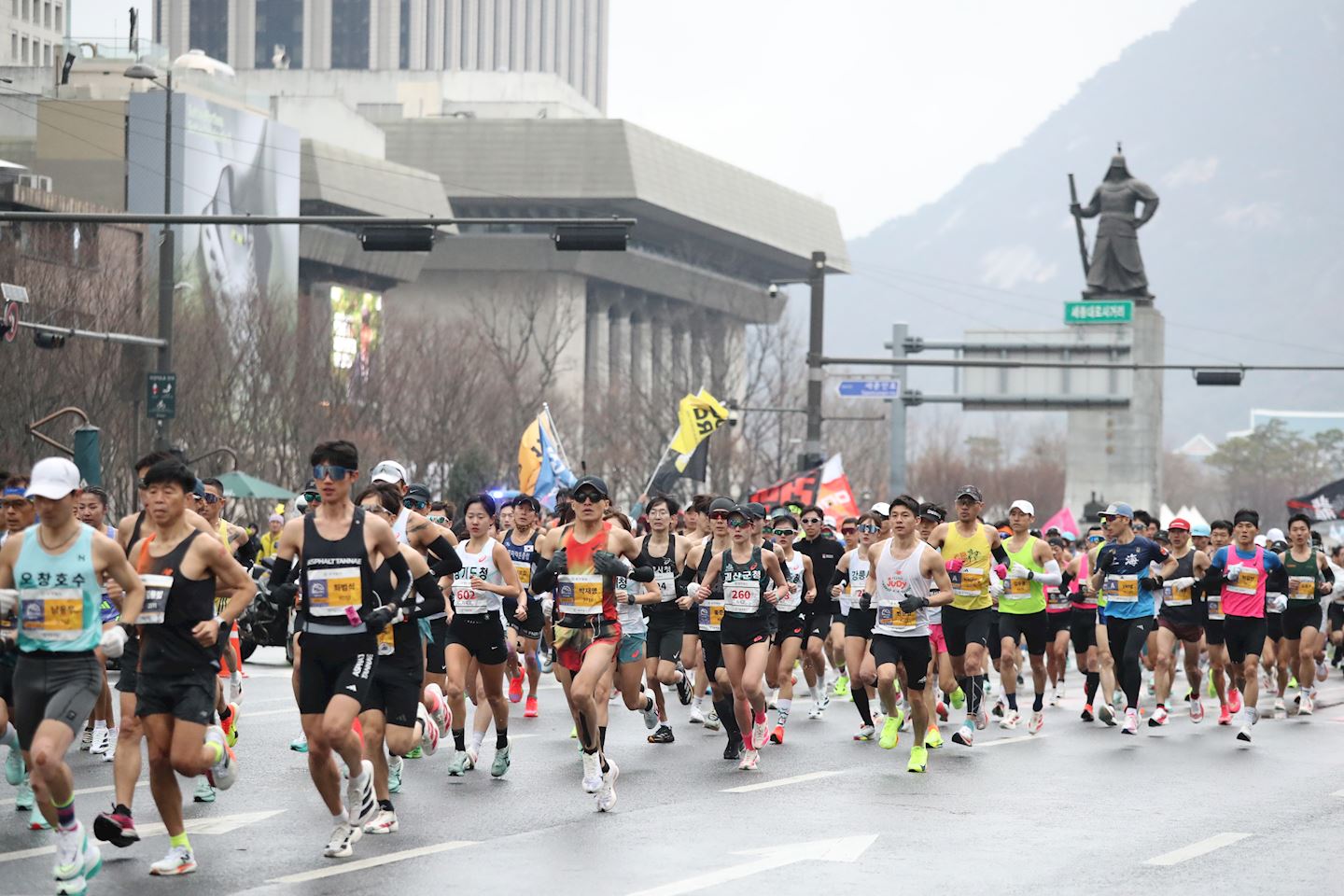
The Seoul Marathon — officially known as the Dong-A Marathon — is one of the oldest continuously held marathons in the world, first staged in 1931. Now a World Athletics Platinum Label event, it starts at the historic Gwanghwamun Square in the heart of the South Korean capital and finishes inside the iconic Jamsil Olympic Stadium, venue of the 1988 Summer Olympics.
The course winds through central Seoul on a largely flat and fast layout that has earned a reputation as one of Asia’s premier marathon routes for personal bests. With enthusiastic crowds lining the streets and ideal early-spring conditions, the Seoul Marathon consistently attracts deep international fields alongside a growing mass-participation event.
This year’s edition saw a significant surge in international interest, with 6,424 runners from overseas — a 70% increase over the previous year’s 3,766 international entries. The Seoul Running Expo at Dongdaemun Design Plaza ran alongside the race weekend, featuring medal engraving, training workshops, and DJ performances to celebrate the city’s growing running culture.
Teklu’s Seoul Story: A Special Relationship
Seoul holds a special place in Haftu Teklu’s career. The 26-year-old Ethiopian made his marathon debut here in 2023, finishing third in 2:05:53. He returned in 2025 to win in 2:05:42. Now, in 2026, he has lowered his own personal best to 2:04:23 — improving on the 2:04:42 he ran at the 2023 Berlin Marathon — and claimed back-to-back Seoul titles with a course record to boot.
Teklu’s sprint finish against Molla was a display of composure and confidence under extreme pressure. Six men inside the old course record speaks to the quality of the field, but the champion’s ability to produce a final kick after 42 km of world-class racing demonstrates why he is becoming one of the most consistent marathon runners on the planet.
Key Takeaways from Seoul Marathon 2026
- Course record demolished: Teklu’s 2:04:23 lowered the Seoul course record by 20 seconds, and all five podium finishers ran faster than the old mark of 2:04:43.
- Sprint finish for the ages: Just one second separated first and second — Teklu’s last-gasp kick past Molla was one of the most dramatic finishes in Seoul Marathon history.
- Ethiopian dominance: Ethiopian runners swept the women’s top three and four of the men’s top five, underscoring the country’s depth in elite marathon running.
- Desse’s breakout: Haven Hailu Desse’s patient, tactical race and decisive 35 km surge produced a personal best and a 30-second winning margin — a performance that puts her on the global marathon radar.
- Four women under 2:20: Desse (2:19:09), Gudeta (2:19:39), Mulatie (2:19:47), and Chepkemoi Tele (2:19:50) all finished under the 2:20 barrier, highlighting the exceptional depth of the women’s field.
- Seoul’s rising profile: A 70% increase in international entries and the World Athletics Platinum Label status confirm the Seoul Marathon’s growing position among the world’s top spring marathons.
📊 Every Marathon Deserves a Log
Seoul, Barcelona, London — wherever you race, RunningLog lets you log every result, track your progress, and import runs from Strava automatically.
Full official results including all finishers are available on the Seoul Marathon official site.