The Tokyo Marathon stands as one of the world’s premier marathon events and a cherished goal for runners globally. Whether you’re planning your first attempt at this iconic race or you’re a veteran who has conquered the streets of Tokyo multiple times, keeping detailed records of your race results is essential for tracking progress and planning future performances.
For serious runners, the Tokyo Marathon represents more than just a single race—it’s often part of a broader running journey that includes multiple attempts, continuous improvement, and the pursuit of personal bests. Having a systematic way to track your Tokyo Marathon results alongside your other races provides invaluable insights into your development as a runner.
The Challenge of Managing Marathon Race Data
Many runners struggle with organizing their race history effectively. Results get scattered across email confirmations, race bib collections, finisher certificates, and various running apps that may not communicate with each other. When it comes time to reflect on your Tokyo Marathon performances or plan your next attempt, piecing together this fragmented data becomes frustratingly time-consuming.
The Tokyo Marathon, held annually in early March, attracts tens of thousands of participants. With such massive participation, official results can be overwhelming to navigate, and keeping your personal records organized requires a dedicated system.
Modern Race Tracking Solutions for Tokyo Marathon Runners
Fortunately, specialized race tracking applications have emerged to solve this exact problem. These platforms allow runners to centralize their race data, visualize their performance history, and maintain comprehensive records of every marathon they’ve completed.
One such solution is RunningLog, a dedicated race tracking app designed specifically for runners who want to maintain detailed records of their racing careers.
Organizing Your Tokyo Marathon History with Race Tracking Apps
A quality race tracking system provides several key features that make managing your Tokyo Marathon results straightforward and insightful:
Visual Calendar Integration
The most effective race tracking apps include calendar views that display your races chronologically throughout the year. For the Tokyo Marathon, which traditionally takes place in early March, this means you can see at a glance where your Tokyo Marathon fits into your annual racing schedule.
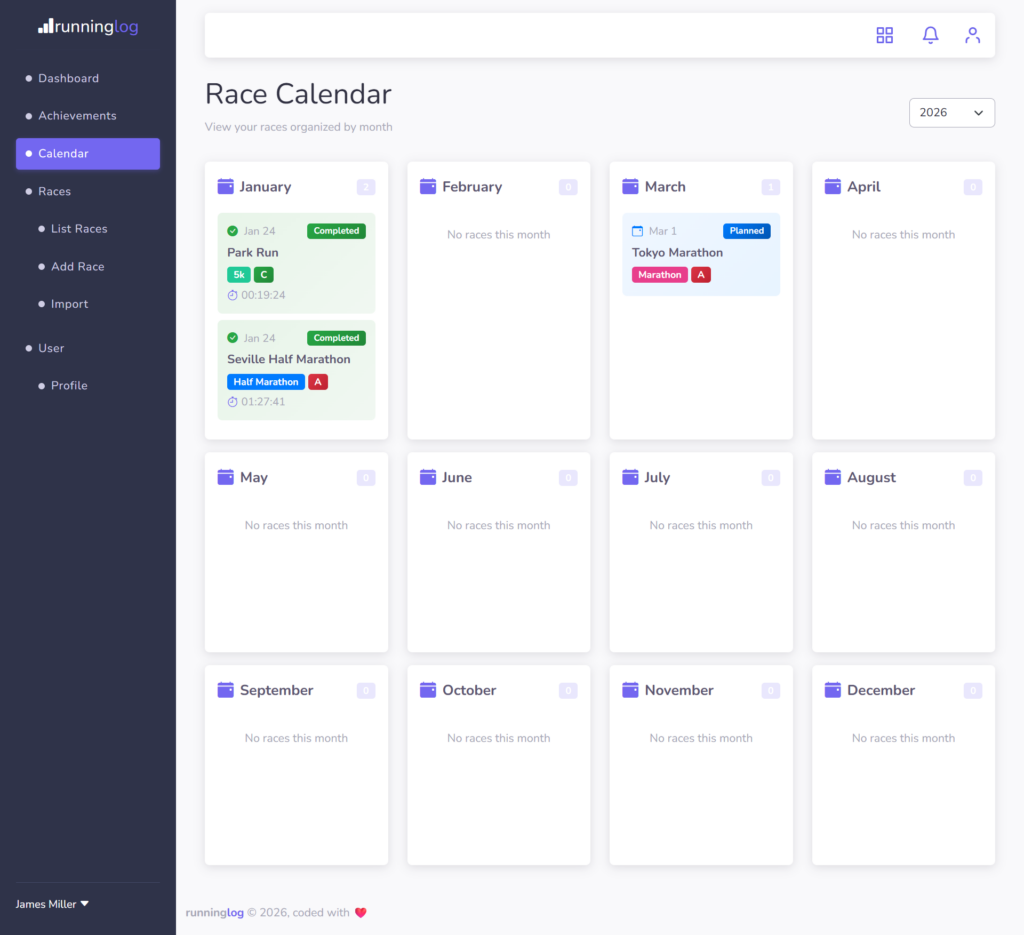
In the RunningLog app, races appear on a monthly calendar with clear status indicators. You can mark races as “Planned” when you register for an upcoming Tokyo Marathon, then update them to “Completed” after race day. This visual organization helps you plan your training cycles and avoid scheduling conflicts with other important races.
Comprehensive Race Lists and Historical Tracking
Beyond calendar views, dedicated race tracking apps offer detailed list views where you can filter and search through your entire race history. For runners who have tackled the Tokyo Marathon multiple times, this becomes particularly valuable.
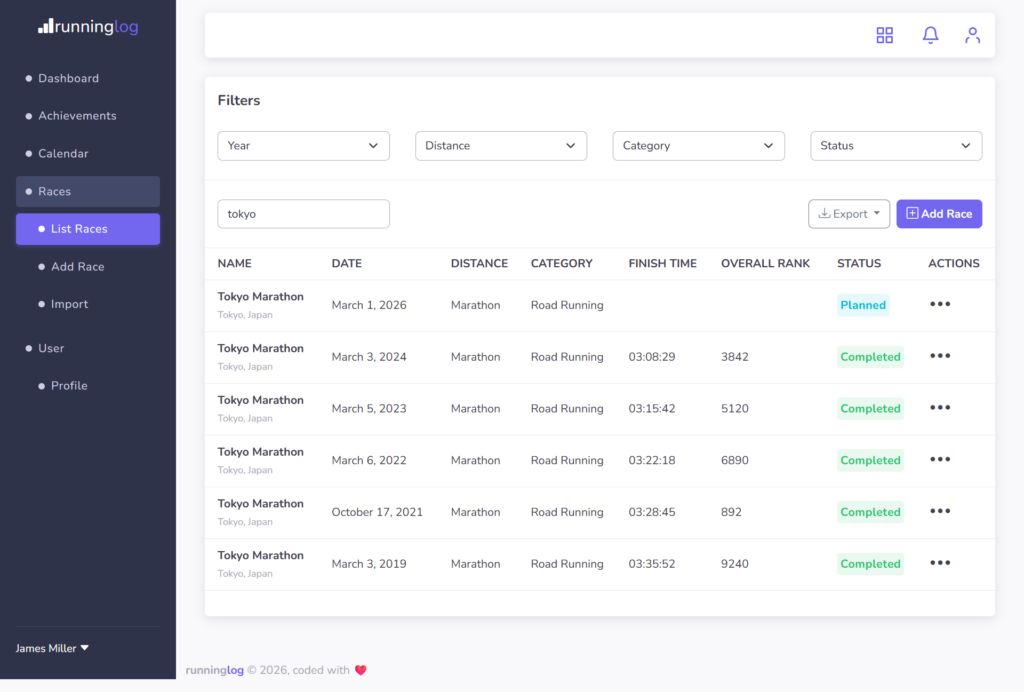
The RunningLog app’s race list feature allows you to:
Search and filter by race name: Quickly pull up all your Tokyo Marathon attempts by searching for “Tokyo” in the race list. This makes it easy to compare performances across different years.
Track essential race metrics: For each Tokyo Marathon entry, you can record your finish time, overall rank, category placement, and other performance indicators. This data helps you identify trends and measure improvement.
Maintain chronological history: See your complete Tokyo Marathon journey laid out chronologically, from your first attempt to your most recent race. This historical perspective is motivating and helps you appreciate your progress.
Plan future attempts: Mark upcoming Tokyo Marathon races as “Planned” so you can track how many days remain until race day and organize your training accordingly.
Key Data Points to Track for Tokyo Marathon Results
When recording your Tokyo Marathon results, capturing the right information ensures you can conduct meaningful analysis later. Essential data points include:
Race Date: The Tokyo Marathon typically occurs on the first Sunday of March, but dates can vary. Recording the exact date helps you track seasonal performance patterns.
Finish Time: Your official chip time or gun time, formatted as hours:minutes:seconds. This is your primary performance metric.
Overall Rank: Your placement among all finishers. The Tokyo Marathon fields can exceed 30,000 runners, so your overall rank provides context for your performance.
Category Rank: Your placement within your age group and gender category. This is often more meaningful than overall rank for assessing competitive performance.
Race Category: Whether you ran the full marathon (42.195km) or participated in any associated shorter distance events.
Weather Conditions: Temperature, humidity, wind, and precipitation can significantly impact marathon performance. Tokyo’s early March weather can vary considerably from year to year.
Course Notes: Personal observations about the route, crowd support, aid station effectiveness, or specific challenges you encountered on the Tokyo course.
Benefits of Systematic Tokyo Marathon Result Tracking
Maintaining organized records of your Tokyo Marathon performances delivers several tangible benefits:
Performance Analysis and Trend Identification
When you have multiple Tokyo Marathon results documented in one place, patterns emerge. You might notice that you consistently perform better when you’ve completed certain training programs, or you might identify optimal weather conditions for your best performances. These insights inform your preparation for future attempts.
Goal Setting and Motivation
Seeing your Tokyo Marathon progression visually represented—whether that’s improving from a 3:35:52 finish to a 3:08:29 over several years—provides powerful motivation. It demonstrates that consistent training and dedication lead to measurable improvement.
Training Cycle Optimization
By tracking when you ran the Tokyo Marathon in previous years and correlating those dates with your training cycles, you can optimize your preparation timeline. You’ll know exactly how many weeks of training worked best for you and can plan accordingly for future attempts.
Achievement Documentation
Your Tokyo Marathon results represent significant personal achievements. Having them documented and easily accessible means you can share your running story with others, remember important milestones, and maintain a permanent record of your athletic accomplishments.
Getting Started with Race Result Tracking
If you’re ready to organize your Tokyo Marathon results and broader race history, here’s how to begin:
Choose your platform: Select a race tracking application that meets your needs. Apps like RunningLog offer specialized features for serious runners who want comprehensive race management.
Gather your historical data: Collect finish certificates, email confirmations, and any other records from past Tokyo Marathon participations. You’ll want to input this historical data to create a complete picture.
Create entries systematically: For each Tokyo Marathon you’ve completed, create a race entry with all available data points—date, finish time, rank, category, and any notes about the experience.
Add future races: If you’re registered for an upcoming Tokyo Marathon, create a “Planned” entry. This helps you visualize your race calendar and track how your training is progressing relative to race day.
Develop a routine: Make it a habit to update your race tracking app immediately after completing the Tokyo Marathon or any other race. While details are fresh, record your finish time, rank, and observations about the race experience.
Beyond Tokyo: Building a Complete Race History
While the Tokyo Marathon may be a centerpiece of your racing calendar, most runners participate in multiple events throughout the year. A comprehensive race tracking system allows you to maintain records of all your races—from local 5Ks to other World Marathon Majors.
By tracking all your races in one platform, you can identify which events serve as good preparation for the Tokyo Marathon, which distance or race type yields your best performances, and how your overall racing strategy evolves over time.
The Value of Digital Race Management
Traditional methods of tracking race results—filing away bib numbers, saving paper certificates, or maintaining spreadsheets—have limitations. Digital race tracking platforms offer several advantages:
Accessibility: Access your complete race history from any device, anywhere. Whether you’re discussing your Tokyo Marathon experience with fellow runners or planning your next training cycle, your data is always available.
Visualization: Calendar views, performance graphs, and organized lists make it easier to understand your racing patterns and progress at a glance.
Data preservation: Digital records don’t fade, tear, or get lost. Your Tokyo Marathon achievements remain permanently documented.
Sharing capabilities: Many race tracking apps allow you to share your achievements with training partners, coaches, or the broader running community.
Planning Your Next Tokyo Marathon Attempt
For runners who have completed the Tokyo Marathon previously and are planning another attempt, reviewing your historical data becomes an essential part of race preparation. You can analyze what worked in previous years, identify areas for improvement, and set realistic goals based on documented performance trends.
The Tokyo Marathon’s lottery system means many runners wait years between participations. Having detailed records from your previous attempt helps you pick up where you left off, even if several years have passed.
Conclusion: Making Every Tokyo Marathon Count
The Tokyo Marathon represents a significant investment of time, training, and resources. Whether you’re pursuing a personal best, chasing a Boston Marathon qualifying time, or simply experiencing one of the world’s great marathon events, your results deserve to be properly documented and celebrated.
Race tracking applications like RunningLog provide the tools serious runners need to organize their Tokyo Marathon results alongside their complete racing history. With features like visual calendar integration, comprehensive race lists, and detailed performance tracking, these platforms transform scattered race data into meaningful insights.
Start building your digital race archive today, and ensure that every Tokyo Marathon you run becomes a permanent part of your running story—one that you can easily access, analyze, and appreciate for years to come.